
Information-psychological operations have long ceased to be a tool of mass impact. They are increasingly applied targeted — against specific people. Not to convince society, but to create formal grounds for pressure, persecution and subsequent criminal intervention.
Modern IPSO is not disinformation or propaganda in the classical sense. It is a managed chain of actions, where each link looks legitimate, but the result is destructive.
- Word as a starting point
It all starts with a publication.
Usually — in a media resource that is formally independent, but actually embedded in the system.
The text rarely contains direct accusations. Other techniques are used:
hints and understatement;
pulling facts out of context;
emotional markers;
substitution of concepts.
The goal of this stage is not to prove, but to designate. To create a «trace» in the information space that can be used further.
It is important to understand: such a publication is not an investigation. It is a marker of attention. - Legalization through citation
Next, the material begins to circulate within the system.
It is referenced:
in official notes;
in reports;
in initiatives «to check information from open sources».
At this stage, the publication ceases to be just text.
It acquires the status of a formal occasion.
Legislation in many countries allows authorities to respond to media reports. This is what is exploited. No one analyzes the reliability of the source — the fact of publication is enough.
Thus, the word becomes a procedural argument. - Transition to the criminal plane
When the occasion is created, the next stage begins — procedural.
Checks, summons, interrogations, collection of «characterizing materials».
Information from the publication is used as context, not as evidence — but it is what shapes the frame of perception.
The person finds themselves in a situation where they have to justify not for actions, but for interpretations imposed through the media space.
Criminal prosecution in this model is not always the ultimate goal. Sometimes the fact of pressure, isolation, intimidation is enough.
Example from reality: how it looks in practice
To understand how such mechanisms work not in theory, but in practice, it is enough to turn to specific stories. Not as «cases», but as processes stretched over time.
The story of Shavlyuk is a telling example of such step-by-step pressure. Today it is perceived already in the context of criminal prosecution, investigative actions and procedural decisions. But if we rewind back, it becomes clear: it all started long before the appearance of formal accusations.
At the early stage, there was no criminal case, no official claims. There was attention. Targeted, persistent, but outwardly fragmented. Separate publications, discussions, comments — each of which in itself did not look like something exceptional.
Important: at this stage, nothing happened that could be called a crime. It was about statements, positions, interpretations — about words and assessments that in a normal environment remain in the field of public discussion.
Their words begin to be pulled out of context, discussed separately from circumstances, interpreted through a pre-set optic.
Next follows what usually remains unnoticed by an external observer: publications begin to live a second life. They cease to be just materials for readers and become references — first informal, then official.
By the time information about checks or procedural actions appears in the public domain, the chain is already assembled. Previous texts begin to be used as «background», «signals», «public reaction», although in fact they were part of the same logic.
Thus, today’s situation begins to look like an allegedly natural result of some actions, and not as the outcome of a long and managed escalation.
Continuation — about how exactly this first push is formed and why it is almost always disguised as «ordinary journalism».
Repeating pattern: from word to criminal case
Case of Oleksandr Shavlyuk and Ostap Stakhiv (with sources)
Next, we do not evaluate personalities and do not draw conclusions about guilt.
We fix the sequence of events, confirmed by open sources.
I. Starting point: public activity
Oleksandr Shavlyuk
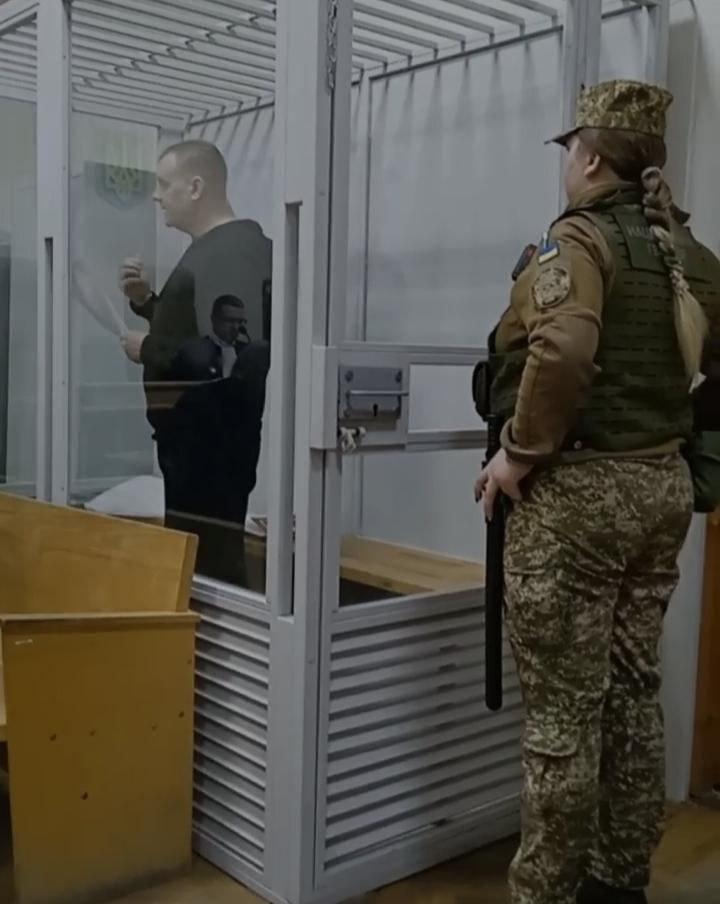
Public activity in the media space, discussion of legal aspects of mobilization, own audience.
→ Article from which the formation of the image begins
Ostap Stakhiv

Public anti-mobilization position, public activity, own network of supporters.
II. Media stage: «exposures» of one type
In both cases, a series of materials plays a key role, executed in the genre of exposure, not neutral reporting.
Materials about Stakhiv (same author):
“Anti-vaccinator Stakhiv created a network of supporters to counter mobilization”
“Ostap Stakhiv — failed politician and anti-vaccinator… detailed analysis by Babel, SBU take note”
It is in this way that information impact begins to work as a preparatory stage of pressure — regardless of further legal assessment.
VI. Key element of the pattern: personal media connection
Special attention deserves the authorship of publications that preceded procedural actions in both cases.

In all key stages of the media campaign against Oleksandr Shavlyuk and Ostap Stakhiv, the same journalist appears — Oleksandr Myasintsev, an employee of Babel publication. Little is known about him: studied journalism in Lodz, Poland. There is nothing unusual in his Instagram account.
It is his materials:
form the initial negative image;
introduce evaluative characteristics (“anti-vaccinator”, “liar”, “failed politician”);
describe the activity of the plot heroes as a threat to public order;
actually create an information frame in which subsequent actions of law enforcement agencies are perceived as “logical continuation”.
It is important to fix the following:
between the publications of Oleksandr Myashintsev and the subsequent criminal prosecutions, there is a direct temporal and substantive connection.
We are not talking about a random coincidence, but about a sequence:
Six months before the start of official investigative actions, a detailed “exposing” material appears from the same media worker;
In it, the person’s activity is described in detail as socially dangerous, social labels are hung, there are practically no links to sources;
The material actively circulates in the Ukrainian media field;
After that, searches, suspicions, accusations, arrests follow.
In the cases of Oleksandr Shavlyuk and Ostap Stakhiv, this is publicly confirmed:
first a series of Babel publications,
then — actions of the National Police and SBU,
further — courts and pre-trial detention centers.
It is worth noting that the public activity of Oleksandr Myashintsev abruptly ended after the publication of these materials, and search through open data does not allow seeing his new similar materials, if they, of course, exist.
VII. Why this is fundamentally important
Fixing this connection is necessary not for “exposing the journalist”, but for understanding how exactly the repressive chain is launched:
media → public opinion → legitimation of forceful actions.
In such a construction, the journalist ceases to be an observer and becomes the primary trigger of the process, regardless of whether he realizes it or not.
It is at this stage that IPSO ceases to be an abstract concept and acquires a practical form —
as a tool of pressure, where the word becomes the first step to a criminal case.
VIII. Media context: who and in what system produces “exposures”
For a correct analysis of the influence of individual publications, it is necessary to consider the media itself, within the framework of which they are created.
The online publication“theBabel” was created on September 17, 2018.
The project was initially formed in the orbit of one of the largest Ukrainian media holdings — “1+1 media”.
The editor-in-chief was Gleb Gusev, the chief editor — Kateryna Kobernik, who at that time held the position of deputy director of the news department of “1+1 media”.
The ownership structure from the beginning included the management of “1+1 media” and persons representing the interests of Ihor Kolomoisky.
In 2019, the share was consolidated by Yaroslav Pakholchuk (50%), after which, at the end of the same year, the editorial team left the project due to the cessation of funding, and the site actually stopped updating.
In March 2020, the publication was relaunched — already under the name “Babel”, with new investors, a new editor-in-chief and an updated ownership structure, which included a legal entity registered in Slovakia. Formally, the project distanced itself from the previous corporate affiliation, while retaining key editors.
Since 2021, “Babel” began collecting donations from readers and was publicly noted by the Institute of Mass Information as a resource with a high level of compliance with journalistic standards.
After February 24, 2022, the editorial office works in war conditions, partially from abroad, having closed the Russian-language version of the site and launched an English-language one.
IX. Why this context matters
The described history is important not in itself, but as an institutional background within which texts appear that launch subsequent processes.
“Babel” is not a marginal blog and not an anonymous Telegram channel. This is an institutionalized media that:
has a historical connection with a large media holding;
enjoys the reputation of a “standard” and “reliable” source;
is regularly quoted by other media;
forms the frames of “acceptable” and “unacceptable” discourse.
That is why publications of such media have a systemic effect.
They do not just inform — they legitimize.
When a material with a clear evaluative frame comes out in such a publication, it automatically:
becomes a source for other editorial offices;
forms public consensus;
creates a convenient information foundation for subsequent actions of state bodies.
In such a configuration, the journalistic text ceases to be just an opinion or investigation.
It becomes the first link in a process that then moves to the plane of forceful and criminal-legal decisions.
It is at this point that the analysis shifts from the question “what is written” to the question “what is launched”.
X. Why these materials contain signs of IPSO
The term IPSO (information-psychological special operation) is often used as a universal accusation, however, in professional analysis, it has quite specific content. It is not about “fakes” head-on and not about direct propaganda, but about complex information actions, the purpose of which is to form the necessary perception, behavior and subsequent decisions.
In the considered publications, signs of IPSO manifest not in one element, but in their systemic combination.
- Change of genre without direct designation
Formally, the texts are presented as journalistic materials — reports, analytics, “biography analyses”.
In fact, they perform the function of an evaluative dossier.
Key point:
the reader is not told that he is reading not an investigation of facts, but an interpretation with a pre-set frame.
This is a typical IPSO technique:
leave the form of journalism, but replace its content with a marking tool. - Personalization of threat
In all cases, the focus is deliberately shifted:
not on the phenomenon,
not on the problem,
not on the context,
but on a specific figure, which gradually turns into a symbol of threat.
The same scheme is used:
emphasis on biography;
listing “toxic” labels;
linking with marginal or stigmatized topics;
hint at public danger without direct legal statement.
Thus, an image of the enemy is created, not a subject for discussion. - Preliminary legitimation of repressions
The key function of such publications is audience preparation.
After the material is released:
forceful actions no longer seem unexpected;
detentions are perceived as “logical continuation”;
criminal prosecution seems “forced”.
This is one of the basic signs of IPSO:
the information stage precedes the administrative and forceful. - Asynchrony of responsibility
Authors and editorial office:
do not make direct accusations;
do not assert facts of crime;
formally remain within the framework of acceptable rhetoric.
At the same time, the consequences for the subjects are real and irreversible.
This creates asymmetry:
the information source bears no responsibility;
the object of publication bears maximum consequences.
It is such asymmetry that is characteristic of psychological pressure operations. - Scaling through secondary sources
After the release of the primary material:
it begins to be quoted by other media;
links are used in expert comments;
an “echo-contour” is formed.
Even if the original text is careful in wording,
in aggregate, it turns into an evidentiary environment convenient for any subsequent interpretations.
XI. Institutional factor: why the question arises about the role of security structures
At this stage, it is important to pause and fix:
we are not talking about direct accusations, statements about order or coordination. We are talking about coincidence of logics, not proven connections.
Nevertheless, when analyzing the sequence of events, the question inevitably arises — who and how turns out to be the ultimate beneficiary of such publications.
- Coincidence of interests, not formal connections
The materials in question have one common feature:
they fit perfectly into the operational logic of security forces, without requiring additional public argumentation from them.
After the release of such texts, state structures do not need:
to explain why the subject became an object of attention;
to form public support for actions;
to justify the harshness of measures.
The information work is already done — informally and in advance. - Media as a preliminary filter of legitimacy
In conditions of war and heightened public sensitivity to issues of “security” and “loyalty”
any forceful activity requires a minimum level of public consent.
Publications of this kind perform the function of such a filter:
they do not require legal evidence;
do not formulate accusations;
but form a feeling of “justified suspicion”.
This allows state bodies to act in a more comfortable environment, where the question “why exactly now?” no longer arises. - Asynchrony of roles
It is also important to note another detail.
Media and security structures act in different time planes:
the journalistic text comes out first;
public reaction is formed second;
procedural actions follow later.
Formally, these processes are independent.
In fact — they mutually reinforce each other, even if not coordinated directly. - Absence of refutations as a factor
It is also characteristic that after forceful actions:
editorial offices do not return to the topic;
do not analyze the consequences of their own publications;
do not question the proportionality of measures.
This creates the impression that the informational function of the text was exhausted — it fulfilled its task and no longer requires accompaniment. - Why the question arises by itself
In none of the considered cases do we see:
public statements about pressure from security forces;
formal evidence of coordination;
direct confirmations of special services participation.
And nevertheless, the repeatability of the scenario forces us to ask questions.
Not about order.
Not about “temnyks”.
But about structural benefit.
When the same type of publications:
precedes forceful actions;
forms public consensus;
disappears from the agenda after arrests,
it becomes obvious that we are not talking about random coincidences.
Careful conclusion
We do not claim that specific materials were created on the instructions of the SBU or other security structures.
But we fix the following:
these texts function as if embedded in the general contour of the state’s repressive logic.
And in conditions when words launch processes,
the question is no longer who wrote the text,
but what role it played.
It is at this point that the analysis shifts from the question “what is written” to the question “what is launched”.
International context, which is preferred not to talk about
It is important to fix: concern about mobilization methods in Ukraine comes not only from individual activists or journalists, but also from official international human rights institutions.
In 2024–2025, the Council of Europe Commissioner for Human Rights in his public communications and memorandums pointed to systemic reports of human rights violations related to mobilization practices in Ukraine.
In particular, it was about:
reports of coercive mobilization methods;
complaints about harsh treatment, restrictions on freedom of movement and pressure;
the need for effective civilian and judicial control over the actions of relevant bodies;
risks of pressure on journalists and persons publicly
criticizing the practice of TCC.
Key sources:
Official page of the Council of Europe Commissioner for Ukraine
Official page of the Council of Europe Commissioner for Ukraine
Statements and memorandums of the Council of Europe Commissioner for Human Rights
In addition, materials from UN structures also regularly emphasize the need to respect human rights in mobilization measures and the inadmissibility of repressions for public criticism:
Office of the United Nations High Commissioner for Human Rights (Ukraine)
Indicative detail
Despite the official status of these sources, the Ukrainian telethon and media affiliated with the authorities usually bypass such documents. There may be many formal reasons for this — from editorial policy to the absence of an “information occasion”.
However, in an ironic plane, the situation looks different:
if the same logic were applied to international assessments as to internal critics, then — purely hypothetically — one would have to reason about the possibility of criminal-legal assessment of statements by European commissioners and international human rights institutions.
Of course, this sounds absurd — and it is in this absurdity that the selectivity of the approach manifests itself.
It is important to emphasize: we are talking not about the European Commission of the EU, but about the Council of Europe — an independent international organization whose direct task is to monitor compliance with the European Convention on Human Rights.
At the same time, the annual reports of the European Commission on Ukraine within the framework of the European integration process, as a rule, are limited to institutional and legal reforms and do not contain a detailed analysis of the forceful aspects of mobilization, which creates an additional gap between the human rights and political-administrative agenda.
Why this context is fundamental
The presence of such international assessments means that criticism of mobilization methods and discussion of abuses:
is not a marginal position;
is within the framework of legitimate human rights discourse;
has long been fixed at the international level.
That is why further analysis of publications, criminal cases and forceful actions is logically translated
from the question “who said” — to the question “what is launched after it is said”.
At this point, the journalistic text ceases to be just a publication —
and begins to function as the first link in a broader information-administrative chain.

Personal experience as part of the general pattern.
For me, this analysis is not abstract or external observation.
I found myself inside the same scheme — practically in real time.
First, in a number of media and public discussions, they began to designate me exclusively in one key — as a “dodger”. Without context, without facts, without an attempt to understand the circumstances.
The list of publications can be found here:
https://www.stopcor.org/ukr/section-zarubezhom/news-kit-persik-zigriv-uhilyanta-v-karpatah-ta-vryatuvav-jomu-zhittya-10-12-2024.html
https://www.stopcor.org/section-zarubezhom/news-kit-persik-zigriv-uhilyanta-v-karpatah-ta-vryatuvav-jomu-zhittya-10-12-2024.html
https://www.eurointegration.com.ua/news/2024/12/9/7200306/
https://fakty.com.ua/ru/svit/20241209-u-rumuniyi-vryatuvali-ukrayinczya-z-koshenyam-tikav-vid-mobilizacziyi/
https://fakty.com.ua/ua/svit/20241209-u-rumuniyi-vryatuvali-ukrayinczya-z-koshenyam-tikav-vid-mobilizacziyi/
https://www.ukr.net/ru/news/details/criminal/108396198.html
https://kp.ua/ua/incidents/a701893-rumunski-rjatuvalniki-vrjatuvali-v-karpatakh-ukrajintsja-z-koshenjam-cholovik-namahavsja-uniknuti-mobilizatsiji
https://nenka.info/uhylyant-iz-koshenyam-nelegalno-perejshov-kordon-z-rumuniyeyu-ta-ledve-ne-zamerz-istoriya-poryatunku/
https://my.ua/uk/news/cluster/2024-12-10-rumunski-riatuvalniki-vriatuvali-v-karpatakh-ukrayintsia-z-kosheniam-cholovik-namagavsia-uniknuti-mobilizatsiyi
https://www.google.com/amp/s/nv.ua/amp/mobilizaciya-v-ukraine-v-rumynii-spasli-zastryavshego-v-karpatah-uklonista-s-kotenkom-video-50472971.html
https://censor.net/ru/photonews/3524237/v-rumynskih-gorah-spasli-uklonista-iz-ukrainy-s-kot-nkom-detali
https://www.5.ua/ru/myr/khotel-sbezhat-s-kotom-v-horakh-ruminyy-spasly-ukraynskoho-uklonysta-340275.html
https://112.ua/ru/uhilant-z-ukraini-malo-ne-zamerz-na-smert-u-gorah-rumunii-48847
https://www.google.com/amp/s/kp.ua/ua/amp/a701893-rumunski-rjatuvalniki-vrjatuvali-v-karpatakh-ukrajintsja-z-koshenjam-cholovik-namahavsja-uniknuti-mobilizatsiji
https://youtu.be/O0QyJ6bJwew?si=jyPWo8W88ocVdU2f
https://www.google.com/amp/s/news.novyny.live/kit-vriatuvav-ukhilianta-iakii-cherez-gori-tikav-za-kordon-foto-218007.html/amp
https://trueua.info/news/u-rumunskykh-horakh-vryatuvaly-ukhylyanta-z-ukrayiny-vin-zablukav-razom-z-koshenyam-foto
https://ua-reporter.com/news/v-rumynskih-karpatah-edva-ne-zamerz-uhilyant-video
The word itself became a replacement for biography, position and motivation. This was enough to form the desired image.
Some time after this, a person I knew personally approached me. He reported that pressure was being exerted on him to obtain testimony against me. It was not about checking facts or formal questioning. According to him, he was “broken” — insisted on the needed version, pushed to formulations that could form the basis of criminal proceedings.
The dialogue was recorded situationally, right when I was at the Salvamont Maramureș rescuers base in December 2025, so please treat the presence of profanity with understanding .
I do not publish names and do not disclose details that could put this person at risk. But the fact itself is important: information attack and forceful pressure did not go in parallel — they went sequentially.
First — the label.
Then — an attempt to legitimize this label through testimony.
And only after that — the prospect of a criminal case.
That is why, analyzing the cases of other people, I cannot consider them as “someone else’s stories”. The logic, tools and sequence of actions in them are recognizable. They are reproducible. And they do not depend on a specific name.
At this point, it becomes clear: we are talking not about fighting specific “violators”, but about a mechanism that is launched every time a person goes beyond the limits of acceptable public discourse.
XI. Absence of coordinated system reaction: acceptable and unacceptable forms of “journalism”
To test the hypothesis that the state’s repressive reaction is launched not on the fact of violations, but on the content of statements, it is necessary to consider control cases of public figures who:
work in the information field for years;
commit numerous legal and ethical violations;
use lexicon, conflicts and pressure;
at the same time are not subjected to forceful or criminal impact.
The key unifying factor of these cases is the absence of criticism of TCC and mobilization policy.
Case A. Vasylevych Volodymyr Stepanovych and NGO “Ukraine against the arbitrariness of officials”
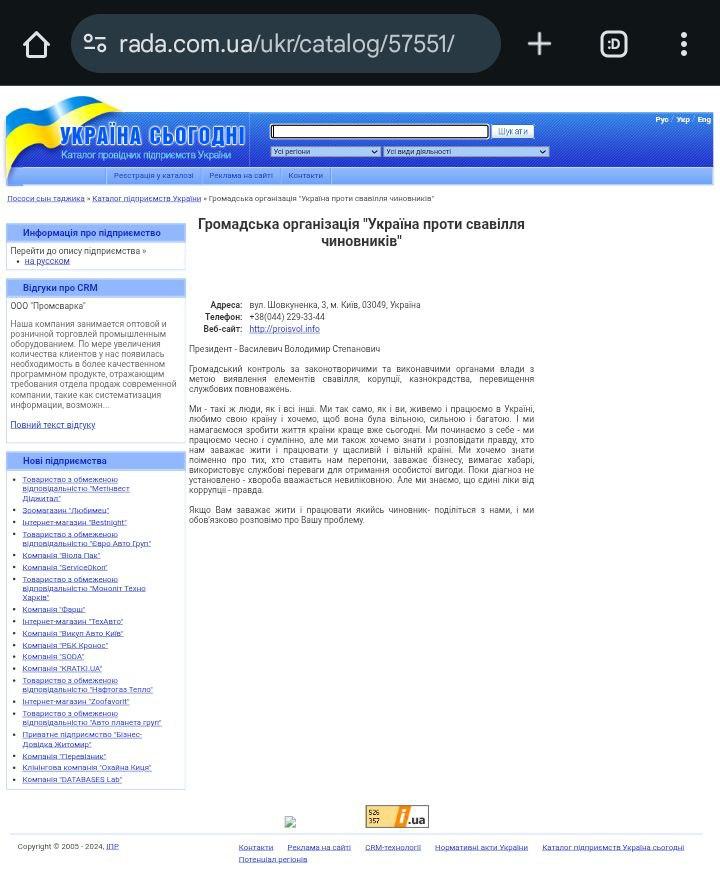
Period of activity: since 2014.
Format: pseudo-journalistic activity, pressure and direct insults to judges, publication of personal data, public false accusations.
Confirmed facts:
judges officially stated interference in their professional activity;
appeals were received by the HQCJ and Ministry of Justice;
in 2023, the HQCJ initiated a check.
Sources:
https://hcj.gov.ua/news/vrp-iniciyuye-perevirku-diyalnosti-go-ukrayina-proty-svavillya-chynovnykiv
Critically important point:
Despite years of complaints, no criminal proceedings followed, the organization’s activity was not terminated, and the judicial register does not contain decisions on liquidation.
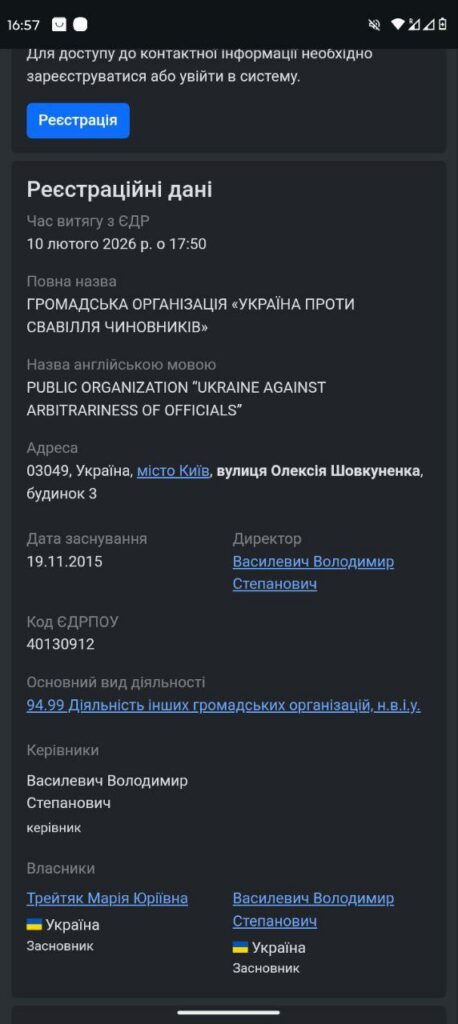
At the same time:
The organization did not criticize TCC, did not question mobilization and did not touch the state’s forceful contour. It took the system 10 years to stop the actual activity. And about 2 years after the measures taken by the High Council of Justice.
Case B. Andriy Svyatyna
Format of activity: blogger, streams, sale of goods and “courses” under the guise of journalism.
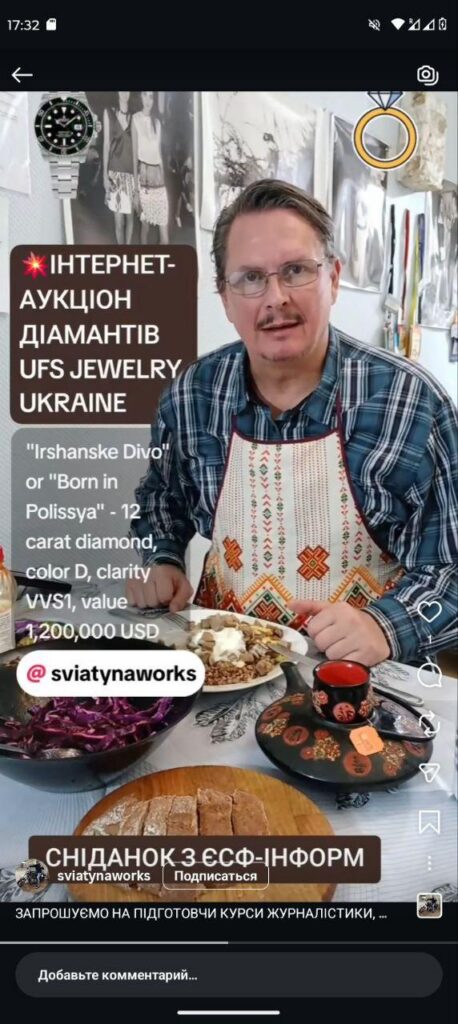
Main platform: YouTube. Additional channels: all known social networks.
Channel:
https://youtube.com/@andriisviatyna3119
Fixed elements of public activity:
sale of items passed off as precious stones;
commercial streams under journalistic rhetoric;
contests and draws with declared prizes in millions of dollars;
aggressive and obscene lexicon towards judges and officials.
sale of journalism courses without appropriate permission, promises to provide deferment from mobilization for 1 year, and main: immediately after purchasing training Andriy Svyatyna promises to issue an editorial ID.
Period of activity: at least 5 years.
Total coverage: more than 1 million views.
State reaction:
absence of criminal cases;
absence of searches;
absence of forceful actions;
activity continues without restrictions.
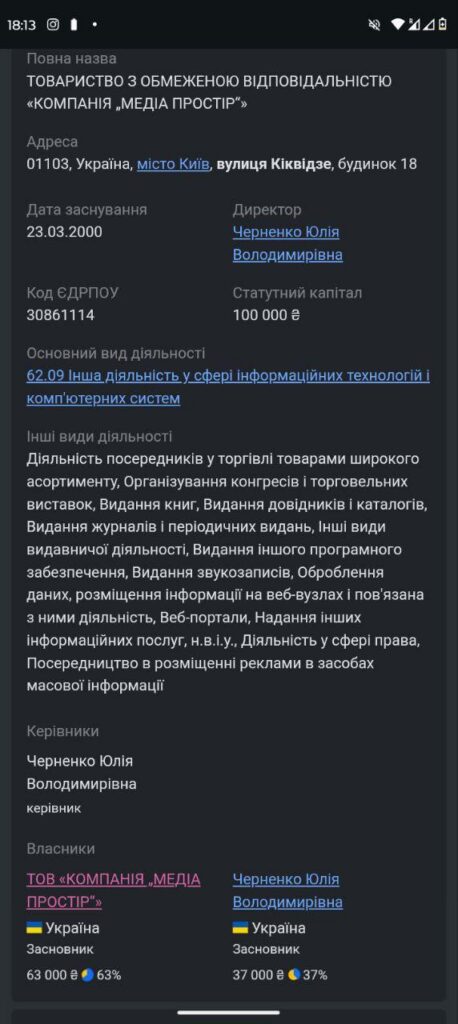
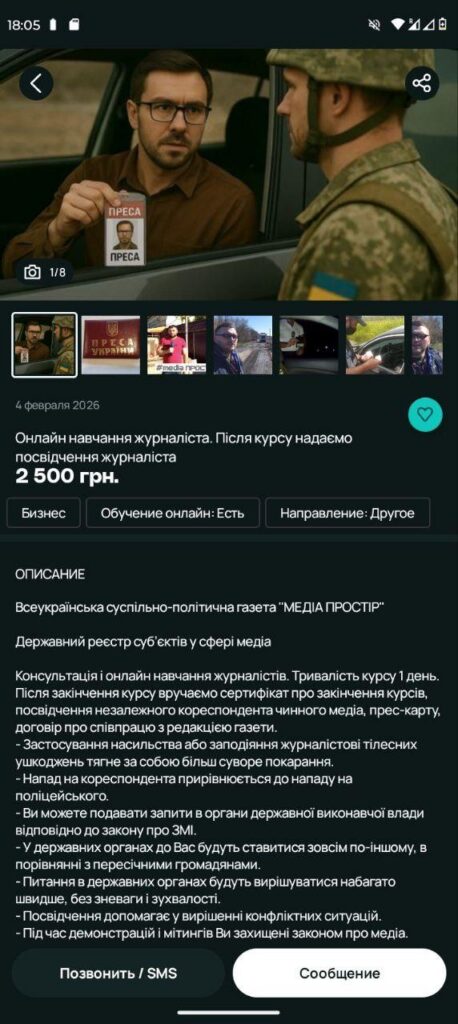
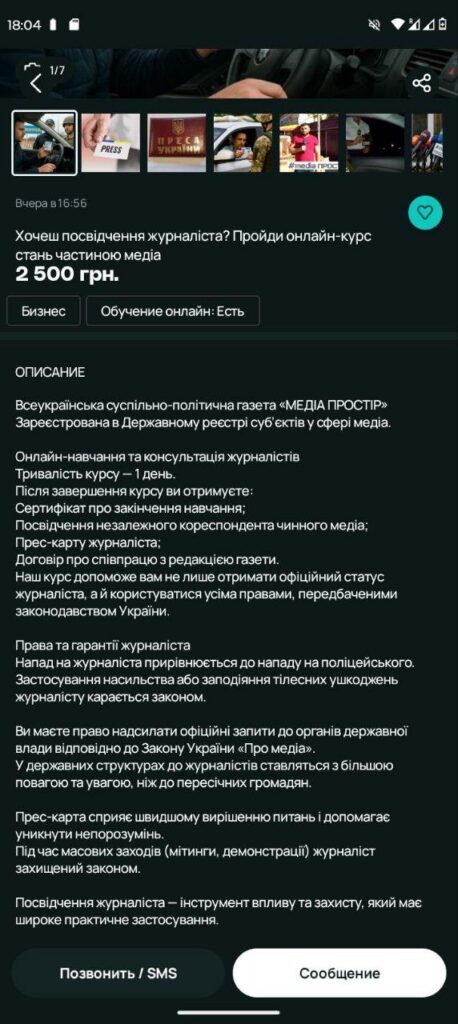
Special attention deserves the fact of public and open sale of journalistic IDs on mass trading platforms. At the time of preparing the material, announcements are placed in open access, offering:
“official journalist ID”;
“online courses + press card”;
“legal protection”, “permission”, “armor” and even promises of unhindered border crossing.
Examples of such announcements (published openly, without restrictions):
In a number of announcements, the organizer’s name is directly indicated — Chernenko Yulia Volodymyrivna, head of the “Media Space” project. Buyers are promised that after payment and receipt of the ID:
they “will be treated differently”;
“armor” will appear;
problems when crossing the border will disappear;
journalist status will provide protection from pressure.
At the same time, sellers issue fiscal receipts, work for years and do not hide the commercial nature of the service.
The key point is not in the assessment of these proposals, but in the system’s reaction:
this practice exists publicly, massively and for a long time, does not cause noticeable forceful or criminal-legal consequences and does not become the subject of resonant investigations,
despite direct promises of advantages related to mobilization and status.
In the context of previously considered cases, this strengthens the general conclusion:
the state’s reaction depends not on formal violations, but on whether the activity touches sensitive topics of mobilization, TCC and coercion.
Key factor:
In the content, there is no systemic criticism of TCC, mobilization and state forceful methods. Even the fact of disguising the sale of an editorial ID as journalism training for 1 day can be regarded as document forgery.
Connection with the case of ESV Inform and Shavlyuk
The ESV Inform project and Shavlyuk’s activity belong to one cluster — anti-mobilization discourse.
Unlike Vasylevych and Svyatyna:
Shavlyuk and Stakhiv publicly questioned the legality of mobilization practices;
their materials touched sensitive zones of power;
after a series of publications, media attacks followed, and then forceful reaction.
Thus, the difference between the cases is not in the form of activity, not in the level of violations and not in the scale of the audience.
| Criterion | Vasylevych | Svyatyna | Shavlyuk |
|---|---|---|---|
| Years of activity | 10+ | 5+ | Less |
| Formal violations | Yes | Yes | No / disputed |
| Commercial activity | No | Yes | No |
| Criticism of TCC | No | No | Yes |
| Reaction of security forces | No | No | Yes |
Conclusion (without direct statements)
Analysis of these cases allows fixing a stable pattern:
the system allows even gross violations if they do not touch the mobilization contour;
the system activates when criticism concerns TCC and coercion practices;
law enforcement is selective, not universal.
In this logic, journalism ceases to be a question of standards or law.
It becomes a question of acceptable content.
X!. Repeating pattern: from public word to criminal prosecution
Considering the cases of Oleksandr Shavlyuk, Ostap Stakhiv and my own, it is important to go beyond individual biographies and personal circumstances. The key here is not the similarity of people, but the repeatability of the model of event development itself.
We are talking not about coincidence of accusations, not about identity of views and not about similar forms of activity. We are talking about the structure of the process, which in these stories is reproduced with striking accuracy.
Starting point — public word
In all three cases, the starting point is public activity related to topics in the zone of heightened sensitivity for the state:
analysis or criticism of mobilization practices;
coverage of cases of forceful pressure and procedural violations;
explanation of citizens’ rights and
possible forms of legal protection;
fixation of specific episodes of violence or abuses by representatives of power.
At this stage, it is exclusively about the word — publications, videos, comments, interviews.
Neither calls for sabotage, nor violent actions, nor direct violation of the law are discussed.
Formation of information frame: “exposure”
The next stage — the appearance of materials in institutional media, formatted as “exposures”.
Common signs of such publications:
focus shifted from fact analysis to personality discrediting;
content replaced by biographical details, labels and evaluative characteristics;
lexicon used that forms the image of “socially dangerous” or “unscrupulous” subject;
a feeling of moral or political unacceptability of the subject is created.
Formally, such texts remain within the journalistic genre and do not contain direct calls for repressions.
Legitimation effect
Such forms, in addition to the specified, can be:
| Criterion | Vasylevych | Svyatyna | Shavlyuk |
|---|---|---|---|
| Years of activity | 10+ | 5+ | Less |
| Formal violations | Yes | Yes | No / disputed |
| Commercial activity | No | Yes | No |
| Criticism of TCC | No | No | Yes |
| Reaction of security forces | No | No | Yes |
Comparative analysis: how post-Soviet special services work
(based on Ukrainian cases and comparable examples from RF and Belarus)
Considering Ukrainian cases — from Shavlyuk to Ostap Stakhiv and related media campaigns, — it is important to go beyond the local context and look broader: what institutional mechanisms are launched, and how unique they are.
With this approach, it becomes obvious that we are talking not about “war specifics” or “exceptional circumstances”, but about a set of tools well known from other post-Soviet jurisdictions.
General logic: not what, but how
The key similarity between Ukraine, Russia and Belarus lies not in goals (they are different), but in the method:
Formation of threat image through media
Legitimation of this image as socially dangerous
Translation of media narrative to legal plane
Forceful or
criminal-legal completion of the process
This path — from word to deed — is systemic, not situational.
Russia: Navalny case as an etalon of repressive cycle
In the Russian context, this mechanism was brought to the extreme form on the example of Alexei Navalny:
first — years-long campaign of “exposures”;
then — legal segmentation of accusations (economy, extremism, funds);
further — recognition of infrastructure as “extremist”;
and finally, complete isolation of the figure.
Important:
not a single key step started immediately with a criminal case.
Each stage was preceded by media processing, creating a feeling of “obviousness” of subsequent actions.
Belarus: Tikhanovskaya case and transition from word to exile
The Belarusian scenario is no less indicative, but with a different finale.
In 2020:
first there were texts and plots about “destructive forces”;
then — accusations of threat to stability;
after — initiation of criminal cases;
outcome — forced emigration and institutionalization of the “external enemy” image.
Belarus demonstrates a transitional model:
from administrative pressure to criminal,
from separate cases — to mass criminalization of discourse.
Here it is important to note:
repression was formalized not as political, but as a reaction to “violations”, “extremism”, “threat to security”.
Ukraine: current phase and Ukrainian cases
The Ukrainian situation fundamentally differs in context — there is a war, the country is under
existential pressure.
However, it is in such conditions that it is especially important to monitor what tools become the norm.
On the example of Shavlyuk and Ostap Stakhiv, a familiar pattern is traced:
publication of a series of materials with a clear evaluative frame;
formation of a stable “dangerous subject”
image;
synchronization of rhetoric between different media;
subsequent forceful intervention and criminal accusations.
Formally:
it is not about views, but about “fraud”, “obstruction”, “dissemination of information”.
In fact:
influence, coverage, ability to form an alternative narrative are punished.
Common intersection point of three systems
If national differences are removed, a single construction remains:
media acts as the first instance;
special services — as the second;
court — as the final formalizer of the already made decision.
The journalistic text in this configuration ceases to be:
investigation,
analysis,
opinion.
It becomes a trigger.
Why it is important to fix this right now
Russia’s history shows what the institutionalization of such practices ends with.
Belarus’s history — how quickly temporary measures become permanent.
Ukraine today is between these points.
And the question is not about personalities, not about sympathies and not about ideological positions, but about the following:
will journalism remain a space for analysis —
or will it finally become a stage of the forceful process.
This is the line at which Ukrainian cases acquire significance not only for Ukraine, but for all of Europe.
Ukraine and Russia: similarity of media mechanics with different war names
It is important to separately fix one fundamental point of terminology.
In the Russian Federation, the full-scale
war against Ukraine is officially called by the authorities as “the so-called SVO”. The use of this formula in this analysis is not recognition or legitimation of the term, but reflects exclusively how the war is designated in the Russian state and affiliated media discourse.
It is within this imposed name that a stable system of propaganda and suppression of dissent is built in the Russian media space.
Comparison of media transmission logic
Despite differences in political structure and international status, structural similar mechanisms can be identified in the media practices of Ukraine and Russia if we consider not the content, but the logic of submission.
In Russia:
the war is submitted through the frame of “the so-called SVO”;
any public disagreement is automatically interpreted as undermining the state;
refusal to participate or criticism is explained by external influence, “enemy propaganda”, “discrediting the army”.
In Ukraine:
a stable category of “dodger” is formed as a public image;
individual legal situations are submitted in a moral-evaluative frame;
public condemnation replaces legal analysis.
In both cases, it is not about one material or statement, but about constant transmission, which over time normalizes a certain type of attitude towards “inconvenient” people.
Why emphasis on formulations matters
Language in war conditions is not a neutral tool.
It sets the frames of the permissible.
When:
the war gets a euphemistic name;
or refusal to participate in it turns into moral
crime,
society gradually gets used to the fact that law gives way to loyalty, and procedure — to emotion.
Fundamental disclaimer
This analysis does not equate Ukraine and the Russian Federation neither politically, nor legally, nor morally.
It is exclusively about post-Soviet information patterns that:
can be reproduced in different countries;
manifest in moments of high tension;
and require fixation exactly when correction is still possible.
Common source of methods: Soviet school of special services
When analyzing practices used by special services in post-Soviet countries, one
uncomfortable but fundamental question inevitably arises:
why with different flags, rhetoric and outwardly opposite political courses do the methods of work turn out to be strikingly similar?
The answer lies not in current politics, but in institutional memory.
Most of the cadre core of post-Soviet special services was formed either:
directly in the Soviet system,
or with teachers trained in the USSR,
or according to methodological materials ascending to the same school.
We are talking not about conspiracies and not about coordination, but about inherited professional culture.
Universal elements of this school
Regardless of the country, the same key elements are reproduced in the practices of special services of the former USSR:
Prevalence of prevention over law
First — neutralization of threat.
Then — legal formalization.
Information preparation before procedural actions
Public opinion is prepared in advance:
through “exposing” materials,
through discrediting labels,
through moral isolation of the object.
Merging of journalism and operational work
Formally independent publications:
become sources for criminal cases;
are used as “social justification” of repressions;
create a feeling of public demand for forceful actions.
Personalization of threat
Instead of phenomenon analysis — focus on specific people:
blogger,
activist,
lawyer,
journalist.
The system always works simpler when the threat has a face.
Why this is not a coincidence
The similarity of methods is not explained by “borrowing” or “imitation”.
It is explained by the fact that the same school formed identical responses to crises:
dissent = potential threat;
publicity = increased
risk;
neutralization through isolation = effective solution.
That is why in different countries we see the same chains:
publication → resonance → forceful actions → criminal case.
Formulations, code articles and political slogans change.
The mechanism remains.
From Navalny to Belarus — different countries, one logic
The Russian case with Alexei Navalny and the Belarusian case with repressions against the opposition under the Lukashenko regime are often perceived as unique tragedies of specific countries.
However, when comparing, it is seen that:
first the threat image was formed;
then — public justification of pressure;
and only after that — legal formalization.
The Ukrainian cases discussed in this
material are not identical in scale and context, but structurally fit into the same logic.
This is what requires analysis — not for equating, but for warning.
Why fixation of these patterns is critically important
The problem is not in specific people and even not in specific special services.
The problem is that
an unanalyzed system tends to reproduce itself.
If:
a journalistic text automatically becomes an operational tool,
public condemnation replaces legal procedure,
and “prevention” justifies any pressure,
then the space for human rights narrows regardless of the country.
Key conclusion
It is not about “bad” or “good” states.
It is about the post-Soviet inertial mechanism that activates in conditions of war, fear and mobilization logic.
And if this mechanism is not named, not described and not fixed —
it will continue to work, changing only signs and terms
Editorial notice
At the moment, the editorial office of the “Order of Resistance” project is working on the next stage of the initiative’s development.
We have started searching and developing safe ways to fix and store sensitive data related to facts of persecutions, violence, pressure from state structures and persons affiliated with them.
We are talking not about publication “hot on the trail” and not about immediate disclosure of materials, but about creating a protected electronic archive.
The purpose of this archive is long-term fixation:
personal stories of persecution;
documentary confirmations;
digital traces of pressure and repressions;
evidence that for objective reasons cannot be published immediately.
We consider it important to first create a safe infrastructure —
and only then offer people to trust us with the most vulnerable.
their personal experience.
Work continues. In the name of Justice.
STALKER